
In-House Kitchen Designer vs Outsourcing: The Real Cost Breakdown
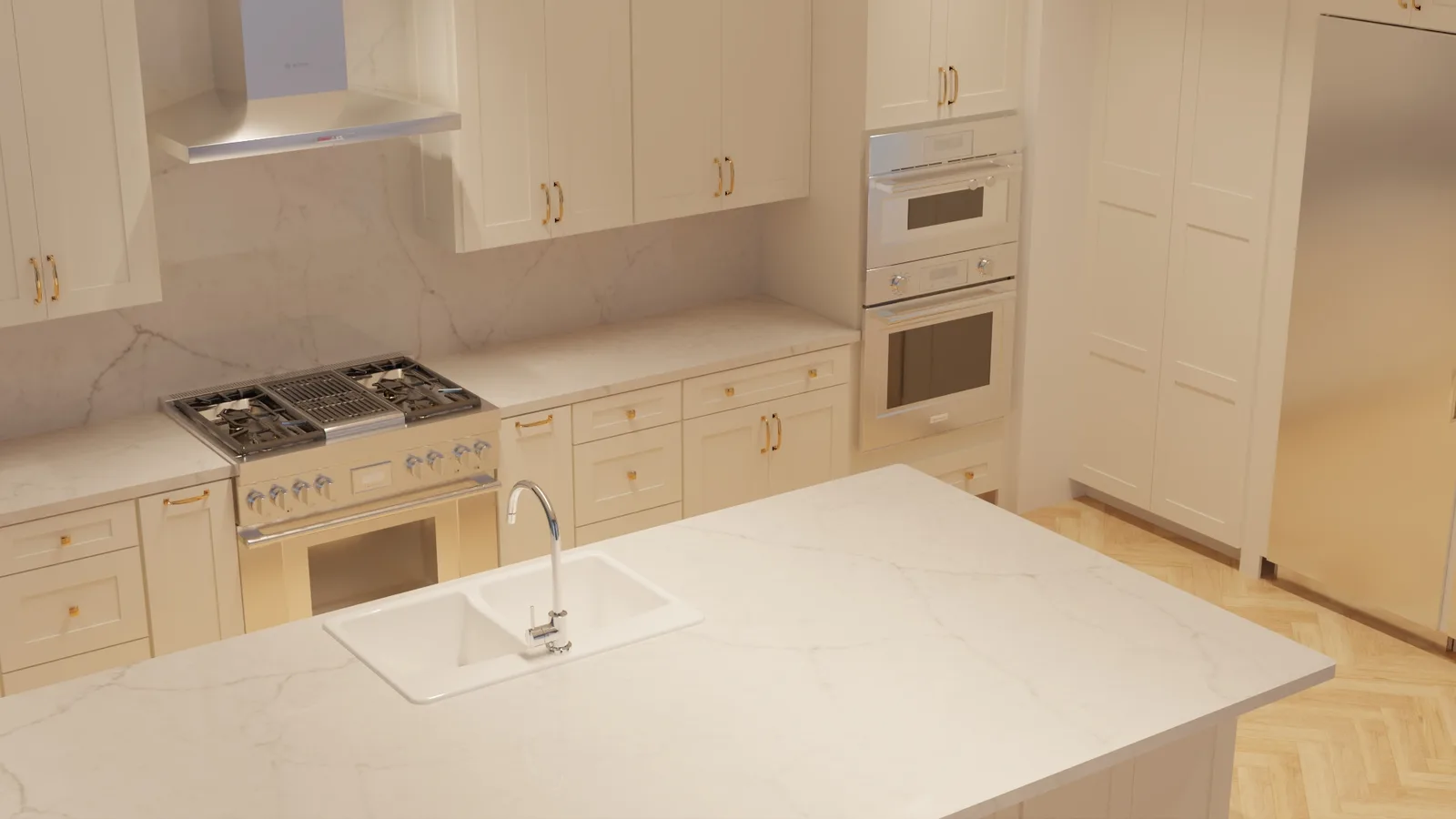
Most cabinet dealers reach the same fork in the road at some point: hire a dedicated in-house kitchen designer, or outsource the work and pay only when a design lands. The answer looks obvious until you run the actual numbers. This article breaks down every line item so you can make the decision with clear eyes.
What an In-House Kitchen Designer Really Costs
The salary is the headline number, but it is rarely the largest line item when you add everything up.
Salary and employment taxes
A mid-level kitchen designer with real 2020 Flex proficiency commands roughly $55,000 per year in most US markets, and that number climbs in coastal metros. Add employer-side payroll taxes (FICA, FUTA, SUTA) and you are already past $60,000 before a single benefit.
Benefits
Health insurance, dental, paid time off, and a modest retirement match typically run 20 to 30 percent of base salary. On a $55,000 base that is another $11,000 to $16,500 per year.
2020 Flex software license
A 2020 Flex desktop seat runs roughly $5,000 to $15,000 per year, depending on tier and cabinet catalog subscriptions. The license belongs to the seat, not the designer, so if your hire leaves you still own the software cost, but you lose the trained user.
Hardware
A workstation capable of rendering photoreal 2020 Flex scenes comfortably runs $2,000 to $4,000. Expect a replacement cycle every three to four years.
Onboarding and ongoing training
2020 Flex has a real learning curve. New-hire training, catalog updates, and periodic refreshers add $1,000 to $3,000 per year, not counting lost billable time during ramp-up, which can stretch to three months.
Overhead
Desk space, utilities, HR time, and management overhead add another $3,000 to $6,000 annually for a single seat.
All-in annual cost: $70,000 to $100,000+
Depending on market and benefit generosity, a single fully-loaded in-house designer costs $70,000 to $100,000 or more per year. At $75,000 annualized, you are paying that cost across every room designed, whether volume is high or low.
The Per-Room Math
This is where the comparison gets concrete. Divide the annual cost by rooms designed per year:
| Monthly volume | Annual rooms | All-in cost per room (at $75k/year) |
|---|---|---|
| 10 rooms/month | 120 | $625 |
| 20 rooms/month | 240 | $313 |
| 30 rooms/month | 360 | $208 |
| 50 rooms/month | 600 | $125 |
Outsourcing to FKD is a flat $100 per design, every time, regardless of room count. A render-only job is $50.
At 10 rooms a month the in-house route costs more than six times as much per room. Even at 30 rooms a month you are paying roughly double. The cost curves do not cross until you are pushing 50 or more rooms per month, which is the approximate break-even point where owning the seat starts to make economic sense.
Hidden Costs the Comparison Tables Miss
The per-room math above already paints a clear picture, but there are a few factors that tilt it further toward outsourcing for most dealers:
Turnover risk. Kitchen designers with strong 2020 Flex skills are in demand. When one leaves, you restart the three-month ramp-up clock and absorb recruiting costs on top.
Capacity ceiling. One designer can handle a fixed number of rooms per day. A rush week, a vacation, or a sick day creates a backlog that stresses client relationships. Outsourced capacity scales up and down with your order volume.
Revision time. In-house, every revision is an internal labor cost. Unlimited revisions are included in FKD’s flat $100 rate with no incremental cost to you.
Scope of deliverables. A solo in-house designer may not produce every asset a client expects. FKD’s standard deliverables include the native 2020 Flex (.kit) file, photoreal renders, dimensioned elevations, floor plans, an items and price list, and a LiveSpace 3D walkthrough, all for the same flat fee.
When In-House Makes Sense
Outsourcing is not the right answer for every business. An in-house designer tends to pay off when:
- You are consistently designing 50 or more rooms per month and volume is predictable year-round.
- Your sales cycle depends on a designer being physically present in a showroom to close deals.
- You work in a highly specialized niche where catalogs and configurations change so constantly that continuity of one dedicated person reduces errors.
Outside those scenarios, the math usually favors outsourcing, particularly for dealers who are growing and do not want to absorb fixed headcount ahead of demand.
The Hybrid Approach
Many of FKD’s 500+ clients run a hybrid model: one in-house designer handles showroom appointments and client-facing presentation work, while overflow volume, rush jobs, and satellite locations are routed to FKD. That keeps the in-house seat load manageable and prevents the designer from becoming a bottleneck during busy months.
Explore how outsourcing kitchen design works and the full comparison of 2020 Design ownership vs outsourcing to see how the economics play out across different business sizes.
Running the Math for Your Business
Take your actual monthly room count, multiply by 12, and divide your fully-loaded designer cost (salary, taxes, benefits, software, hardware, training) by that number. If the result is significantly above $100, outsourcing frees up budget that can go directly into sales, inventory, or showroom improvements.
FKD delivers more than 15,000 designs a year for dealers, remodelers, and online retailers across all 50 states. There are no contracts, no seat fees, and no minimum volume commitments. You pay $100 when you need a design and nothing when you do not.